Typhoid fever is a systemic infectious disease caused by Salmonella typhi. It remains a public health challenge in many developing countries, including Indonesia. Variations in the clinical manifestations of typhoid fever are strongly influenced by bacterial load, the host immune response, and environmental risk factors, which ultimately determine the severity of the disease. Early diagnosis is crucial because delayed treatment increases the risk of serious complications such as gastrointestinal bleeding, ileal perforation, or even sepsis. The greatest clinical challenge is that its symptoms are non-specific, making it difficult to differentiate from other infections. This highlights the need for rapid, practical detection methods that support early screening.
1. Bacterial Load and Its Relationship to Pathogenesis
Bacterial load reflects the number of Salmonella typhi organisms that successfully invade the host’s body. The greater the bacterial load:
• the higher the risk of bacteremia,
• the stronger the inflammatory response,
• and the greater the likelihood of severe clinical manifestations.
These bacteria can penetrate the intestinal mucosa, proliferate in lymphoid tissues, and spread through the bloodstream. This systemic dissemination leads to the multisystem symptoms observed in typhoid fever.
2. Host Factors Determining Clinical Variability
The host’s immune response plays a major role in determining the course of the disease. Key factors include:
• Nutritional status: Deficiency of vitamin A, zinc, or protein-energy worsens cellular immunity.
• Age: Children and the elderly tend to have suboptimal immune responses.
• Comorbidities: Diabetes, anemia, or immunosuppressive conditions increase the risk of severe disease.
• Host genetics: Genetic variations affecting inflammatory responses can determine symptom severity.
These factors explain why two patients exposed to the same infection source may experience different levels of severity.
3. Variability of Clinical Manifestations
The clinical manifestations of typhoid fever range from mild to severe. Early symptoms are usually non-specific, such as:
• gradual fever,
• headache,
• malaise,
• gastrointestinal disturbances (constipation or diarrhea),
• nausea and anorexia.
In cases with a high bacterial load or weakened host condition, symptoms may progress to:
• hepatosplenomegaly,
• delirium (typhoid state),
• gastrointestinal bleeding,
• ileal perforation.
4. Importance of Early Detection
Early detection of typhoid fever is essential to prevent progression to severe stages. Confirmatory methods such as blood culture have high sensitivity but require time and laboratory facilities. Therefore, the need for rapid screening tools is increasing, especially in endemic areas.
Rapid tests can serve as useful tools for initial screening so patients can receive further diagnostic evaluation.
Product Advantages: ACCU-TELL® Typhoid Cassette (Whole Blood/Serum/Plasma)
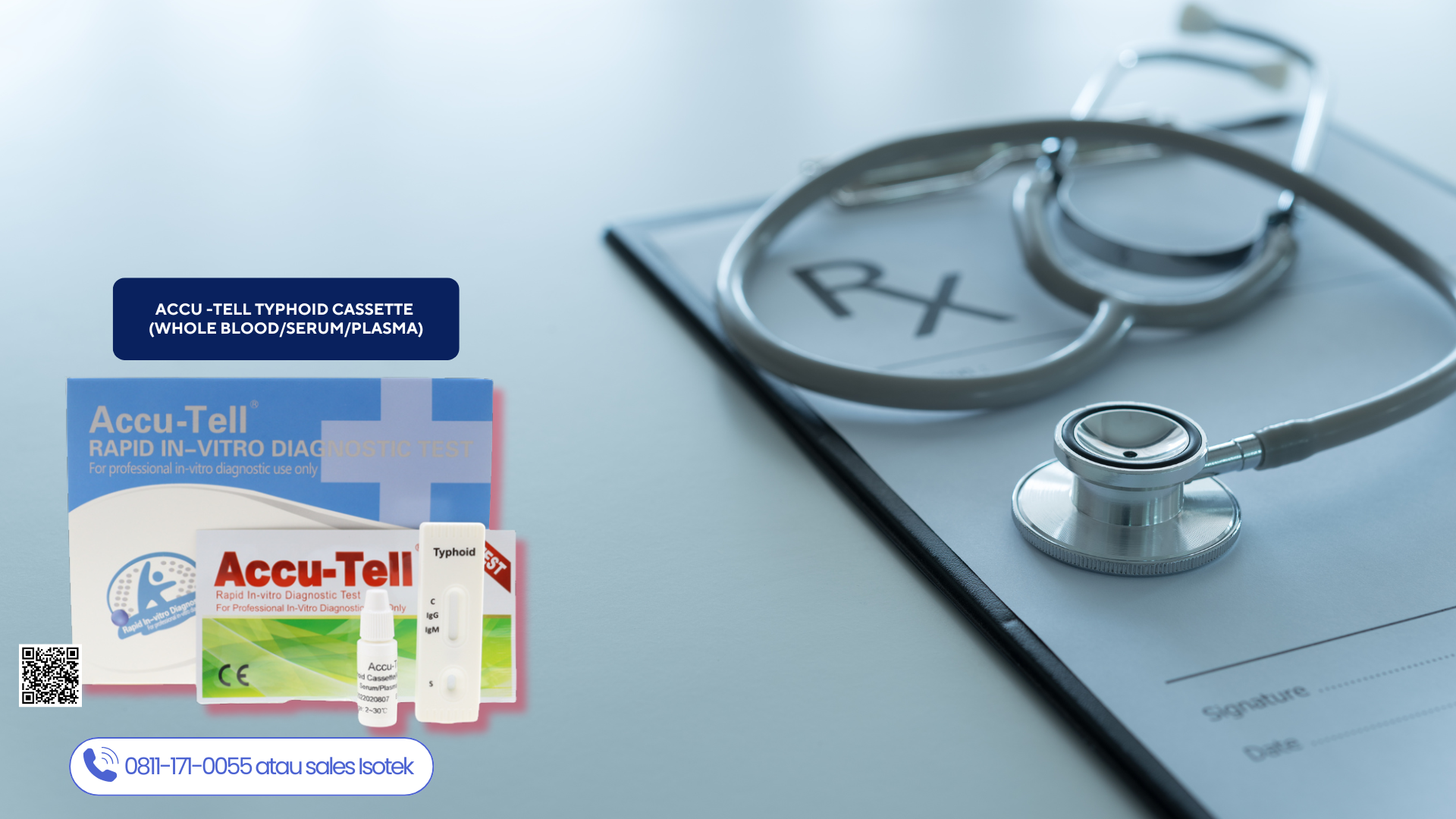
In the context of the need for fast and practical early screening, the ACCU-TELL® Typhoid Cassette (Whole Blood/Serum/Plasma) is one of the most widely used options in healthcare facilities for early detection. Its advantages include:
• Utilizes a rapid chromatographic immunoassay principle, allowing easy interpretation of results through visible colored lines in a short time.
• CE certified and registered with the Indonesian Ministry of Health (AKL).
• Shelf life of 2 years from the production date.
• Compatible with three sample types: whole blood, serum, and plasma, providing flexibility based on sample availability.
• Results can be interpreted within 10 minutes, enabling clinicians to make timely decisions.
• Effectively detects IgG and IgM antibodies against Salmonella typhi in whole blood, serum, or plasma.
• Includes 1 buffer bottle for 20 tests.
A. Clinical Performance:
• IgG: Sensitivity 89.5%; Specificity 97.2%; Accuracy 96.5%
• IgM: Sensitivity 87.9%; Specificity 97.4%; Accuracy 96.3%
B. Contents of Each Box:
a. Test cassette
b. Plastic capillary pipette
c. One buffer bottle
d. Insert pack
The clinical spectrum of typhoid fever is influenced by the interaction between bacterial load, S. Typhi virulence, and host factors that shape the immune response. The higher the bacterial load and the weaker the host condition, the more severe the clinical manifestations. Early detection is key to reducing complications. In the initial screening process, the use of tools such as the ACCU-TELL® Typhoid Cassette (Whole Blood/Serum/Plasma) can accelerate the identification of cases requiring further testing. With timely screening and rapid treatment, the risk of disease progression can be effectively minimized.
References
-
Crump, J. A., & Mintz, E. D. (2010). Global trends in typhoid and paratyphoid fever. Clinical Infectious Diseases.
-
Parry, C. M., Hien, T. T., Dougan, G., White, N. J., & Farrar, J. J. (2002). Typhoid fever. The New England Journal of Medicine.
-
Wain, J., Hendriksen, R. S., Mikoleit, M. L., Keddy, K. H., & Ochiai, R. L. (2015). Typhoid fever. The Lancet.
-
WHO. (2023). Typhoid fever fact sheet. World Health Organization.
-
Buckle, G. C., Walker, C. L. F., & Black, R. E. (2012). Typhoid fever and paratyphoid fever: Systematic review. PLOS Neglected Tropical Diseases.